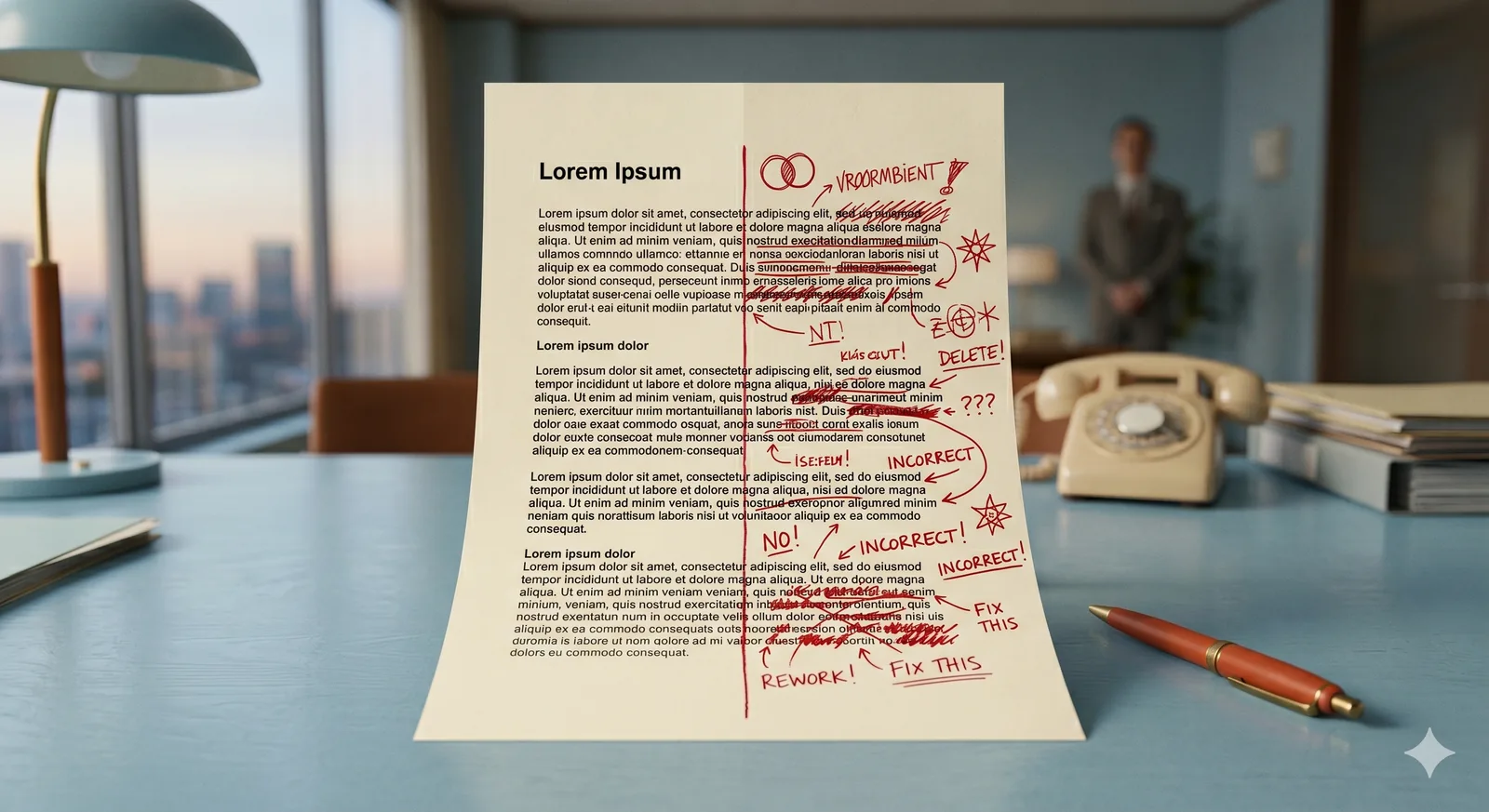

AI made deep work nearly free, and your most expensive readers still give it 45 seconds. The fix is architectural: ship decision-carrying work in three layers generated from the deep work under one rule, no new claims.
An operating partner at a private equity firm recently told me how long a document gets to prove itself on his desk: about 45 seconds. Not because he’s careless. Because everything crosses his desk, from every company, every week, and most of it arrives the same way: at full depth, with no way in. The work itself wasn’t the complaint. Most of it was thorough, reasoned, genuinely good. His complaint was simpler. Everyone sends the depth, and nobody sends the key.
That conversation gave me a name for something I’d been watching everywhere AI touches serious work. But first we need to talk about the two names everyone else is using, because neither one covers it.
Two named failures, and a third with no name
In September 2025, researchers at BetterUp Labs and Stanford’s Social Media Lab gave us workslop: AI-generated content that “masquerades as good work, but lacks the substance to meaningfully advance a given task.” The mechanism is burden transfer. The sender saves time; the receiver spends nearly two hours figuring out what they were just handed. In the survey, 40% of respondents said they’d received workslop in the past month. Hold that number loosely: the survey is self-selected and still collecting responses as you read this, which is also why I’m not repeating its widely quoted dollar figures. This post is about to argue that untraceable numbers are the disease. I’m not going to hand you any.
Then in June 2026, Marc Zao-Sanders added thinkslop: “the lazy, sloppy thinking that can be engendered by excessive use of AI.” So workslop is bad output. Thinkslop is bad input, letting the machine do your thinking and nodding at whatever comes back.
Both terms are useful. Both describe deficits: not enough effort, not enough thought. And notice what every prescription attached to them has in common. Use AI responsibly. Don’t outsource your judgment. Set norms, add accountability, think harder. Even the loudest critic of the workslop research, David Gerard, who called the article “sales trash” while admitting the word itself was perfect, lands on a behavioral diagnosis: blame the bosses and their AI mandates. Three camps that agree on almost nothing, and all three prescribe fixing people.
Here’s the failure none of them names. The work that is good. Researched, reasoned, checked, and still useless to its audience, because it arrived at full length when the reader had 45 seconds. Bad work dressed well has a name. Good work undressed for its audience doesn’t.
Call it depth-locked: work whose value is real but sealed at a depth its most important readers will never reach. It’s what actually afflicts competent people doing serious work with AI. And it’s not a discipline problem. It’s an architecture problem.
The executive-communication playbook assumed depth was expensive
Executive communication had this handled for decades. Barbara Minto’s Pyramid Principle: answer first, reasoning beneath, structured so the reader can stop at any level and still leave with something whole. The military’s BLUF. Amazon’s six-page narrative memo. Axios sells the instinct as Smart Brevity. Consultants build decks where the titles alone tell the story. UX people call it progressive disclosure.
Every one of these is an editorial discipline, and every one quietly assumes depth is expensive. When a deep analysis costs weeks of someone’s time, there aren’t many of them, and a senior person shapes each one on the way up. The scarcity did half the work. The pyramid never had to scale, because depth couldn’t.
AI broke that assumption. Depth is nearly free now, and everyone can produce it: the well-structured report, the fifteen-tab model, the appendix nobody asked for. The volume isn’t the problem; much of this work is real. The problem is that editorial discipline was priced for scarce depth, and “write shorter” was advice for a world where writing long was hard.
One detail from the old playbook deserves rescue, though. Amazon’s real innovation was never the six-pager. It was the silent reading time at the start of the meeting: attention allocated structurally, not requested politely. A format standard without a consumption norm is a suggestion. Hold that thought; we’ll need it.
The fix is a layer, not a diet
Every deliverable that asks a reader to decide something should ship in three layers.
- Single click. One page. The stance, the ask, and the few numbers that carry it. Readable in under a minute. This is what earns the reader’s patience for everything below.
- Double click. Three to five pages. The reasoning, the tradeoffs, the evidence highlights, structured so every line of the single click expands into a section here.
- Triple click. The full work. The model, the analysis, the appendix. All of it.
I know. So far this sounds like an executive summary with better branding. The difference is where the layers come from. You don’t write the upper layers. You generate them from the deep work, as projections, under one rule that isn’t negotiable:
No new claims. Nothing may appear in a layer that isn’t present in the layer below it. Every number, fact, and conclusion on the one-pager exists in the double click; everything in the double click exists in the full work. If producing a coherent one-pager requires a fact the deep work doesn’t contain, the deep work isn’t finished.
That rule is what makes this architecture instead of formatting, and it’s worth being precise about why. Executives read long documents defensively because summaries editorialize. Every hand-written summary is a fresh chance for a claim to shade, a hedge to vanish, a number to round in the flattering direction. So a careful reader verifies, which means reading the whole thing, which means the summary saved nothing. The product was never brevity. It’s trust. A one-page view the reader can trust completely beats ten pages they have to check, and the no-new-claims rule is what buys the right to be brief.
The rule also runs backwards, as a lie detector on your own work. Can’t project a one-page stance from your analysis? Then it isn’t analysis yet. It’s research still looking for its conclusion. I’ve watched this rule refuse to produce a page, and the refusal was the most valuable output of the week.
Two habits fall out of the architecture:
Never patch the single click. Everyone hand-edits the exec summary at 11pm before the board meeting. That’s the exact moment it detaches from the work and becomes just another summary: editorialized, unverified, untrusted. Fix the layer underneath and regenerate the page.
Lead with a stance, not findings. “Six of the eleven tools in our martech stack overlap in function” is a finding; it asks nothing of the reader. “Cut the stack from eleven tools to five at renewal” can be wrong, and that’s exactly what makes it worth 45 seconds. Findings can only be inaccurate. Stances can be wrong. Senior readers give attention to things that can be wrong.
A single-click page, then, looks something like this (numbers invented for illustration):
Recommendation: Pull out of the spring trade show and move the €60K ($70K) into the webinar program before the booth deposit is due March 1.
The numbers that carry it: Events produced 8% of pipeline on 30% of program budget last year. Cost per qualified opportunity: €3,100 ($3,600) from events against €700 ($820) from webinars. The team can run six more webinars with zero new headcount.
What we don’t know yet: how much brand visibility the booth buys; we’ve never measured it.
The ask: approve the reallocation before the deposit deadline.
One page. Nothing appears here that isn’t underneath. A reader can stop, or pull any thread and land exactly where that claim is defended.
So who reads the deep layer?
Machines, mostly. And that’s fine.
This is the reframe that kills the guilt about volume: the audience for your triple click changed. It was never really the operating partner, and now it doesn’t have to pretend to be. The deep layer is for machines and for verification. Retrieval systems, AI answer engines deciding whether to cite you, auditors, the analyst who inherits the project, your own AI tools six months from now when nobody remembers why the decision was made. Depth for machines, brevity for humans. Write the depth without shame. Just stop shipping it as if a human were going to read it cold.
One wrinkle I ran into researching this post: the machine-readable web is now adversarial. When my research agent fetched one of the critiques cited above, the site detected a bot and served it deliberately scrambled text, chopped-up Orwell where the article should be. This is a whole genre now, tarpits with names like Nepenthes and Iocaine, and Cloudflare ships a poisoned maze of its own, AI Labyrinth, as an off-the-shelf feature. Sites feed garbage to machines on purpose, as a defense. If your deep layers are increasingly written for machine readers, remember that what a machine retrieves is no longer guaranteed to be what a human would see. Which is one more argument for the same rule: claims trace to sources, and somewhere in the chain, a human checked. I’ve written about what happens when nobody checks: an industry’s most-quoted stats tracing back to sources their own authors had already retired.
I run this architecture on my own work
This isn’t theory I’m recommending from the shore. In a current engagement, I stopped authoring status reports altogether: the work lives in a structured source of truth, humans approve every change to it, and the report is generated as a view of that source. Status became a byproduct of work instead of a Friday authoring job. Then I realized strategy documents are the same disease one level up, so I built the layering into my own delivery too: a tool I call Single-Click that takes finished deep work and generates the one-page and mid-depth views under the no-new-claims rule.
The most useful thing it does is refuse. When it can’t extract a stance from the deep work, when the analysis is findings and options all the way down, it doesn’t generate a diplomatic page. It stops and says the work isn’t done. I wrote in January that AI did the hard part and then the hard part started. This is what the hard part turned out to be. Not producing the depth. Building the thing that makes depth consumable without making it untrustworthy.
Is your work depth-locked?
Not everything needs layers. The test is one question: does this deliverable ask the reader to decide something? Decision-carrying work gets layered: asks, proposals, investment cases, recommendations. Informational work doesn’t: status updates, FYIs, documentation. Layering a status update is ceremony.
If it qualifies, this week’s version of the fix needs no tooling:
- Take one finished, decision-carrying deliverable and write its single click: one page, stance first, ask last, every number pointing to where it lives in the full work.
- Enforce no-new-claims on yourself. If the page needs something the deep work doesn’t contain, the deep work isn’t done. That sting is the diagnostic working.
- Set the consumption norm when you send it, Amazon-style: “The one-pager is the pre-read. The rest exists when you want it.”
- Next deadline, when you’re tempted to hand-edit the single click: don’t. Fix the layer below and redo the page. That habit is the whole architecture in miniature.
There’s a bigger idea underneath all this, and I’ll only wave at it for now. If the upper layers are projections governed by claims, then the real unit of professional work may not be the document at all. It may be the claim, with every document, page, and report just a view over the claims, generated for a particular reader. That thought reaches well past executive communication, and it deserves its own post.
For now, the practical version is its own single click. Your best work isn’t failing because it’s too long. It’s failing because you shipped it locked and kept the only key. And keys, finally, are cheap to cut.
Frequently asked questions
How is this different from an executive summary?
An executive summary is written by hand, which makes it a fresh chance for a claim to shade or a number to round in the flattering direction, so careful readers verify it by reading the whole document anyway. The layers here are generated from the deep work under the no-new-claims rule: nothing appears in a layer that isn’t present in the layer below, which is what lets a reader trust the one-pager without checking it.
Which deliverables should be layered?
Only decision-carrying work: asks, proposals, investment cases, recommendations. Informational work doesn’t qualify: status updates, FYIs, documentation. Layering a status update is ceremony.
Who reads the full-depth layer?
Machines, mostly: retrieval systems, AI answer engines deciding whether to cite you, auditors, the analyst who inherits the project, and your own AI tools six months from now. Write the depth for verification; ship the brevity to humans.
Sources and Further Reading
- AI-Generated “Workslop” Is Destroying Productivity — Kate Niederhoffer, Gabriella Rosen Kellerman, Angela Lee, Alex Liebscher, Kristina Rapuano, Jeffrey T. Hancock; Harvard Business Review, September 22, 2025
- Why People Create AI “Workslop” — and How to Stop It — Harvard Business Review, January 2026
- How People Are Really Using AI in 2026 — Marc Zao-Sanders, Harvard Business Review, June 2026
- Thinkslop — Marc Zao-Sanders, One Thing at a Time (Substack), June 3, 2026
- Workslop: bad ‘study’, but an excellent word — David Gerard, Pivot to AI, September 23, 2025
- What are AI tarpits? Understanding the tools people are using to poison LLMs — Michael Grothaus, Fast Company, May 16, 2026
- Trapping misbehaving bots in an AI Labyrinth — Reid Tatoris, The Cloudflare Blog, March 19, 2025
- AI Did the Hard Part. Then the Hard Part Started. — The AI Strategist, January 27, 2026
- You Can Do It All Yourself Now. That’s Exactly the Problem. — The AI Strategist, June 16, 2026