

Content generation is solved. Delivery isn’t.
Last week I wrote about how your business experience becomes the edge when everyone has access to the same AI. The argument: knowing what to build matters more than knowing how. Technical execution is increasingly commoditized. Judgment isn’t.
This week, I got to test that theory.
The Setup
I was wrapping up a four-month client engagement—a custom marketing attribution system for a company spending millions annually on ads. The technical work was done. Now came the handoff: comprehensive documentation for three different audiences. Executives who needed to understand business value. An offshore operations team who’d use the system daily. Future developers who might need to modify the architecture.
Using Claude with detailed context files, I generated about 20 documents in roughly three hours. Executive summaries. Quick-start guides. Data dictionaries. Incident playbooks. Architectural decision records. Everything the client’s team would need to operate and maintain the system without me.
The AI did exactly what it was supposed to do. Fast, comprehensive, structured content that would have taken me days to write manually.
Then I looked at what I actually had.
The Decision That Mattered
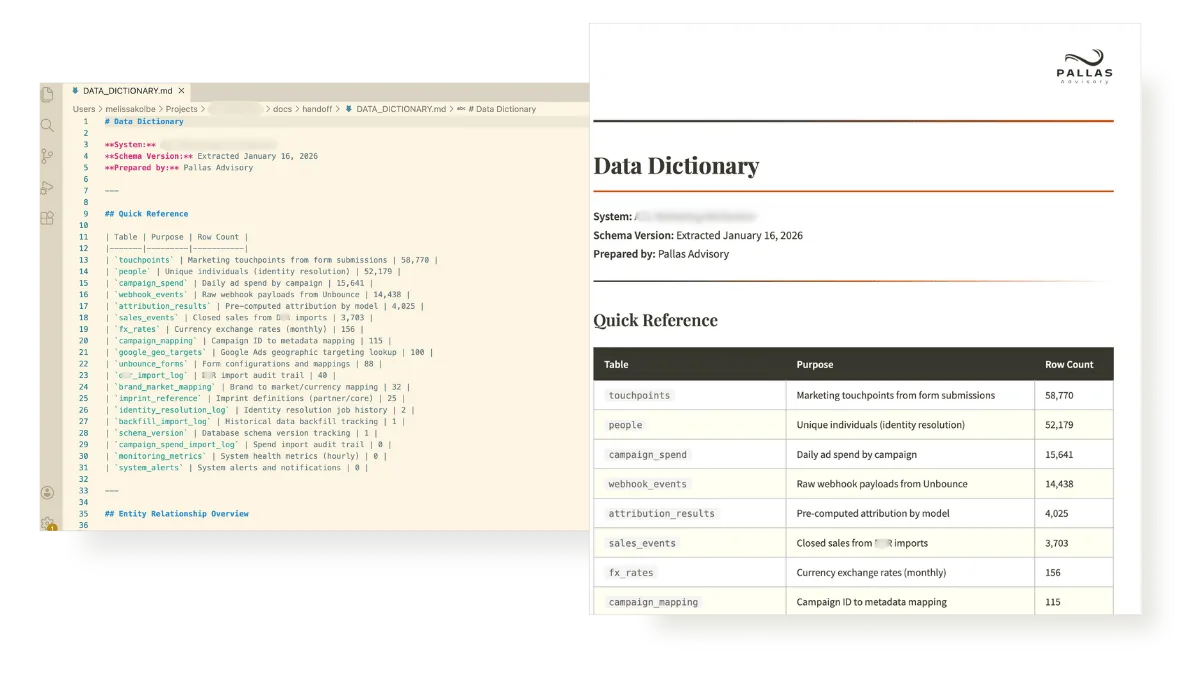
Twenty markdown files sat in a folder. They looked great in a code editor. They weren’t remotely client-ready.
Here’s where a developer and a consultant diverge.
A developer’s instinct: share the git repository. It’s version-controlled. It’s technically elegant. Everything’s organized and accessible.
My instinct, shaped by years of handing things to clients: that’s not how this works. Clients don’t navigate repositories. They forward PDFs to their boss. They print things for meetings. They want something that opens in one click and looks like it came from a professional consultancy.
That judgment—knowing what “done” actually means in context—had nothing to do with AI capability. The AI could generate the content. It couldn’t know that the format of delivery matters as much as the content itself.
What I Built Instead
Rather than manually formatting 20 documents in Google Docs (I estimated 8-16 hours of work), I spent a few hours building something different: a self-hosted API that converts markdown to branded PDFs automatically.
Write in markdown—fast, version-controlled, AI-friendly. Send it to the API. Receive a professionally branded PDF with logo, colors, typography, and page numbers. Zero manual formatting.
Those 20 client documents now go from markdown to branded deliverable in seconds. The infrastructure cost essentially nothing. The time investment was a few hours of building versus a future of manual formatting on every engagement.
But here’s what matters: the decision to build that infrastructure wasn’t a technical insight. It was a client experience insight. I built it because I knew what the output needed to become—not because I knew how to build it.
This Is What the Theory Looks Like in Practice
Last week’s post argued that AI makes your business experience directly executable. The person who’s spent years in an industry knows which things matter—and now they can build systems that reflect that knowledge.
This week was that principle showing up in an actual deliverable.
The AI handled generation. I handled the judgment about what “done” looks like. Neither was sufficient alone. But the judgment was the part that couldn’t be commoditized.
If I’d been a developer without client-facing experience, I might have shipped the repo and moved on. Technically complete. Contextually wrong. The kind of “done” that creates friction instead of trust.
The Broader Pattern
This isn’t unique to documentation or PDFs. The pattern shows up everywhere AI generates output:
The AI produces content. Someone has to know what that content needs to become—what form it should take, who will receive it, what “professional” or “complete” or “ready” means in that specific context.
That translation layer is where business experience lives. It’s the gap between “AI did it” and “it’s actually done.”
For small business owners: Every proposal, report, or client document involves this gap. AI can draft it. You know what it needs to look like when it lands in the client’s inbox.
For marketing leaders: Content generation at scale still requires judgment about format, channel, brand consistency, and stakeholder expectations. The generation is the easy part.
For DAFT entrepreneurs building practices abroad: Professional appearance matters more when you’re establishing credibility in a new market. The gap between “functional document” and “polished deliverable” is where trust gets built or eroded.
What This Means for You This Week
If last week’s post was about the theory—your judgment becomes the differentiator when AI capability is everywhere—this week’s takeaway is simpler:
Pay attention to the decisions you make after AI generates something. The choices about format, delivery, presentation, and context. Those are the places where your experience is doing the work that AI can’t.
And if you find yourself making the same judgment calls repeatedly—like “clients need branded PDFs, not markdown files”—that’s a signal. You can encode that judgment into infrastructure, the way I did this week. Turn a recurring decision into a system.
That’s what building on your experience actually looks like now.
Where This Gets Practical
Most businesses I work with have versions of this gap—places where AI-generated output doesn’t quite become operational because no one’s defined what “done” actually means in context. That normalized friction between “content exists” and “client receives it” is exactly the kind of thing that compounds over time.
If you’re not sure where those gaps are hiding in your workflows, that’s the kind of problem I help solve. No pitches, just a conversation about where judgment could become infrastructure.
Sources:
- When Everyone Has the Same AI, Your Business Experience Becomes the Edge – Pallas Advisory