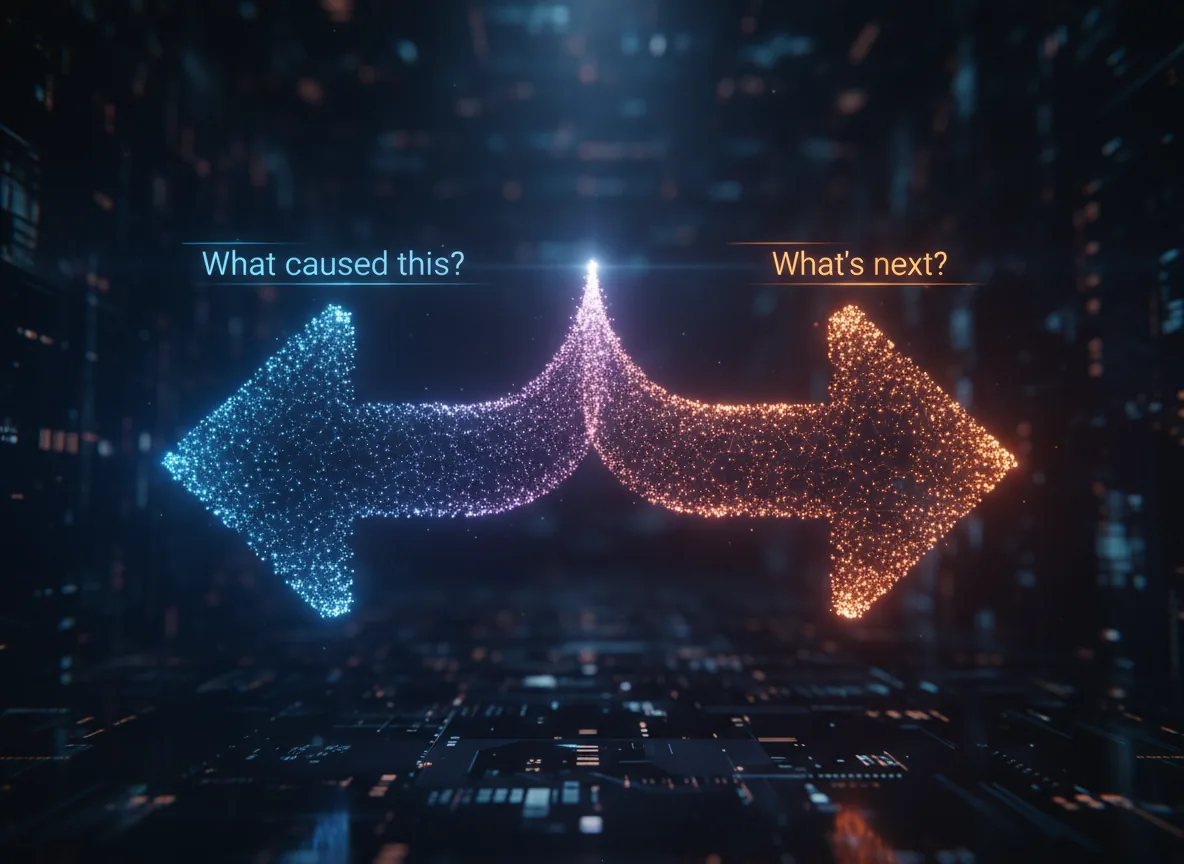
Spent a month designing attribution infrastructure for a B2C client. Discovery finding: everyone’s asking the wrong questions. The event streams that tell you “what caused this conversion?” also tell you “what’s about to happen?” – but nobody’s running those queries.
Week three of attribution discovery, and I realized I’d been designing the wrong system.
The client asked for attribution: “Help us understand which content drives conversions.” Standard request. Standard approach – map the journey, design the event schema, figure out what to track.
But as I worked through which events to capture and which queries the system needed to answer, the pattern became obvious: attribution and operational intelligence are the same technical problem.
The event streams that tell you “this reader engaged with 7 posts over 6 weeks before converting” also tell you:
- Which subscribers are about to churn
- Which content to publish next
- Who to reach out to right now
Everyone’s building attribution to measure the past. Almost nobody’s using that same infrastructure to predict the future.
Here’s what discovery revealed, and why it changes implementation strategy.
What Everyone Asks For vs What the Data Actually Enables
The attribution questions everyone wants answered:
- Which channel gets credit for this conversion?
- What’s the average journey length before purchase?
- How much should we spend on each acquisition source?
The operational intelligence questions using identical event streams:
- Show me readers who engaged with 3+ product posts but haven’t purchased – what’s the pattern?
- Which email subscribers stopped opening after issue two – can we predict that earlier?
- Which content converts drive-by traffic into subscribers vs gets views but no follow-through?
Same events. Same infrastructure. Different queries.
The real example that crystallized this:
Client wanted to know: “What percentage of conversions viewed content first?”
But the event data that answers that question also answers: “Show me active email subscribers who engaged heavily with product content but haven’t seen our new launch post – should we feature it?”
One is backward-looking measurement. The other is forward-looking action.
They require the exact same technical foundation.
Why This Matters for Event Schema Design
This realization completely changed my discovery recommendations.
Originally scoping: “Track enough to calculate attribution”
Discovery finding: “Track enough to answer ‘what should we do next?’”
Practical difference in what we capture:
| For Attribution Only | For Operational Intelligence Too |
| Page view event | Page view + scroll depth + time on page |
| Email open event | Email open + which links clicked + time spent |
| Content view event | Content view + topic tags + position in sequence |
Why it matters:
Attribution needs to know: “They viewed content”
Operational intelligence needs to know: “They engaged deeply with product content, spent 4+ minutes, came back twice”
The second approach costs barely more to implement. But it unlocks entirely different capabilities.
The Platform Economics Nobody Explains
This is why enterprise platforms for “next best action” cost $50K-$500K/year.
Salesforce Einstein: Needs complete event streams to recommend next actions
HubSpot AI: Requires behavioral event data to score and route leads
They’re not selling magic AI. They’re selling:
- Event infrastructure (storage + capture)
- Query logic (pattern detection)
- Action integration (connect to email/CRM/etc)
Discovery finding: Once you have #1 for attribution, #2 is just… different queries. #3 is integration work, not platform magic.
That doesn’t make it free. You still need to:
- Build the logic for “what pattern means what action”
- Integrate with systems that execute those actions
- Test whether recommendations actually work
But it means: The $100K+ you’d spend on an operational intelligence platform is mostly paying for event infrastructure you’re already building for attribution.
The Data Reality Nobody Wants to Hear
Two questions came up repeatedly during discovery:
“How much data do you actually need?”
For basic attribution: 30-50 conversions to see patterns
For operational intelligence: 200-300+ complete journeys (converters AND non-converters)
Why the difference? Attribution just needs to distribute credit. Operational intelligence needs to identify “what worked” vs “what didn’t work” – which requires seeing both outcomes.
Timeline for this client:
- Month 1-2: Basic attribution patterns visible
- Month 3-6: Engagement scoring becomes reliable
- Month 6-12: “Next best action” recommendations have statistical confidence
You can run queries from day one. But confidence in predictions grows with volume.
“Can you backfill historical data?”
Partially. And this changes implementation timeline dramatically.
What you CAN reconstruct:
- Email platform exports (usually granular user-level data)
- E-commerce purchase history (user IDs + timestamps)
- CRM interaction records (contact history preserved)
What you CANNOT reconstruct:
- Individual user engagement depth (GA4 stores averages, not user-level)
- Content view sequences within sessions (aggregated before storage)
- Cross-device journeys (unless ID resolution was running)
The cruel reality: Most analytics tools aggregate before storing. You can’t un-aggregate data.
Google Analytics tells you “average time on page: 2:34” but doesn’t store “User X spent 4:12, User Y spent 1:03.” That individual-level data is what operational intelligence needs.
Practical strategy I recommended:
Start capturing events NOW (even imperfect) → Backfill what platforms export (6-12 months of email/purchase data) → Accept that granular content engagement before this week is lost forever
Don’t wait for perfect. Start capturing now. Some historical context is gone regardless.
The Real Discovery Finding
Everyone’s building attribution wrong.
They’re designing for: “What happened and who gets credit?”
They should be designing for: “What happened, what’s about to happen, and what should we do about it?”
The technical foundation is identical. The business value is 10x different.
What makes this possible now:
- Event storage is cheap (cents per thousand events)
- Query engines are fast (BigQuery, Snowflake, even Postgres)
- Integration APIs are everywhere (webhook-first platforms)
The $50K platforms aren’t holding magic. They’re running queries on event streams you probably already have – or could build for $2-10K/month instead of $5-9M.
The hard part isn’t the infrastructure. It’s deciding:
- What events actually matter vs create noise
- Which patterns signal action vs are just interesting
- When to act on predictions vs wait for more data
That’s strategy work. Not platform work.
What This Means For You
You probably need this if:
- Spending $100K+/year on marketing with attribution blindness
- Drowning in tools but can’t answer “what should we do next?”
- Paying $50K+ for operational intelligence platforms
You probably don’t need this if:
- Just starting (nail one channel first)
- Under $50K marketing spend (focus beats infrastructure)
- Happy with “good enough” attribution
How to evaluate:
Ask: “If I could see every customer touchpoint and ask any question about patterns, what would I ask?”
If the answer is just “which channel gets credit?” – you need better attribution.
If the answer is “who should I reach out to? what should I publish next? who’s about to churn?” – you need operational intelligence.
And that’s the same system.
The attribution system behind this is written up as a case study: An attribution system, built in six weeks, outside Salesforce.