
Enterprises captured what happened. They forgot to capture why. You haven’t—yet
Your AI can tell you that you gave a 20% discount last quarter. It cannot tell you why.
Was it a one-time exception for a client who experienced service issues? A precedent you should replicate? A margin mistake you shouldn’t repeat?
The CRM stores one fact: “20% discount.” The reasoning—the service tickets, the escalation thread, the Slack conversation where your sales lead explained the situation—was never captured as data. It exists somewhere, scattered and decaying.
This is the $10 million question enterprises are suddenly desperate to answer. And it’s one most small businesses can answer today—if they recognize what they’re sitting on before they lose it.
The Trust Gap Nobody Expected
The “Agentic AI Futures Index” from last month reveals something striking: 73% of enterprises are making significant investments in AI reasoning and decision intelligence—the highest commitment of any capability measured. But only 49% trust their AI to make accurate decisions. Trust scores: 2.4 out of 5, the lowest across all dimensions.
Enterprises are buying the car but can’t find the keys.
The problem isn’t the AI. It’s that decades of “data infrastructure” investment captured outcomes while discarding reasoning. As one analysis put it: “Systems of record store outcomes but not reasoning. They capture what decision was made, not why. Context—prior exceptions, supporting signals, human approvals, precedent—is rarely stored in a structured form.”
When humans run workflows, they reconstruct context from memory and experience. When AI agents try to act, the missing reasoning becomes a hard wall. Every case gets treated as new, even when the organization has resolved identical situations dozens of times.
IBM’s researchers are blunt: autonomous AI decision-making requires “big leaps in contextual reasoning.” The models are ready. The context isn’t.
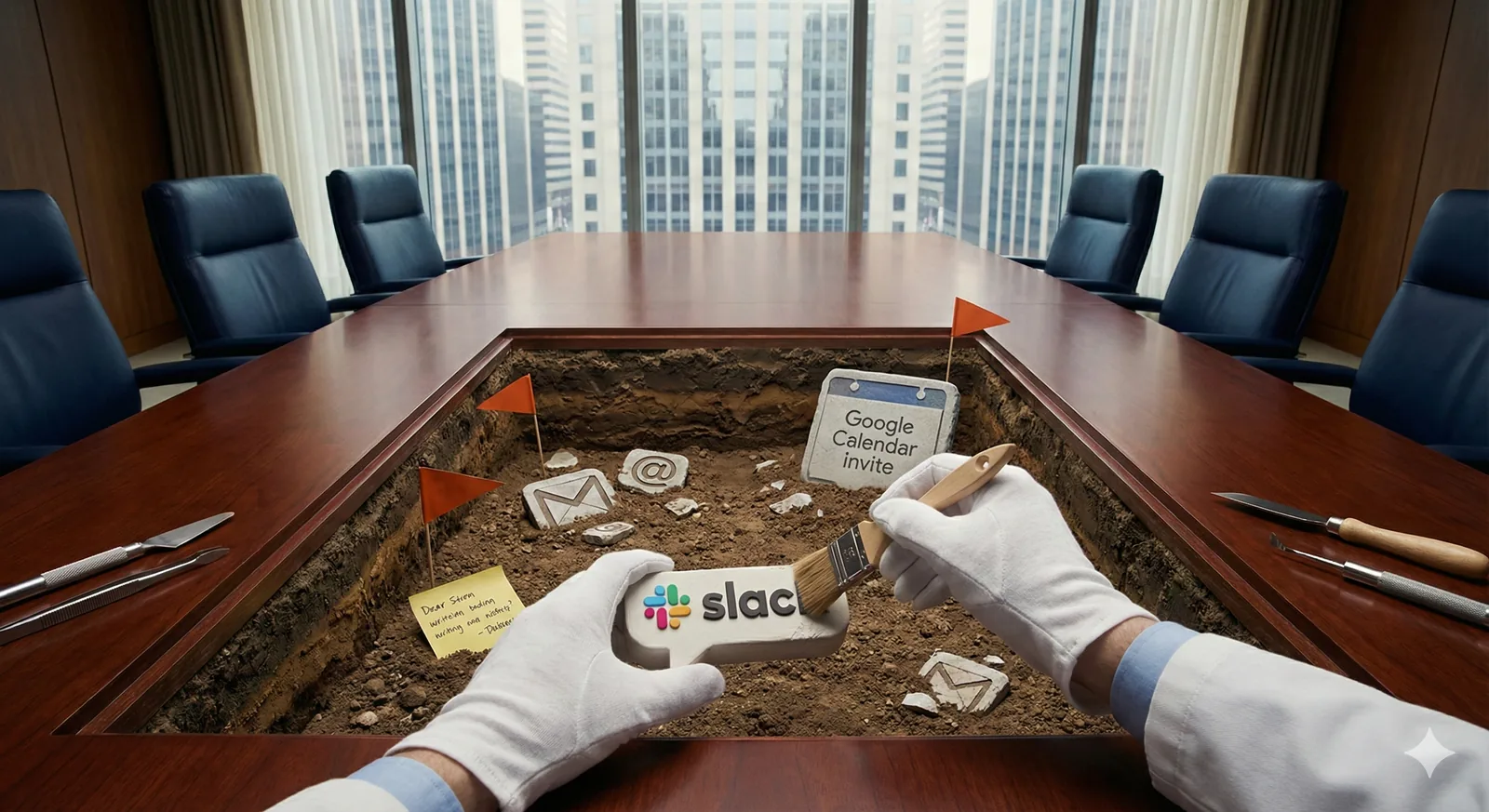
The Archaeology Problem
When an enterprise wants to understand past pricing decisions, here’s what they find:
The CRM shows approved discounts. The ticketing system shows escalations. The email archive contains thousands of unsearchable threads. Slack history expired 90 days ago. The people who made those decisions rotated teams or left entirely.
Reconstructing the why requires what consultants call knowledge archaeology—interviewing employees, cross-referencing systems, piecing together fragments. McKinsey charges six figures for this work. The result is still incomplete.
When a 15-person company needs to understand why they made that pricing exception last quarter, someone searches Slack. Maybe checks email. The person who made the decision is probably still there. Total time: fifteen minutes.
This isn’t because small businesses have better systems. It’s because decisions flow through fewer people, and the reasoning hasn’t had time to scatter.
But here’s what nobody says out loud: this advantage has an expiration date. The moment you add team members, change tools, or just let enough time pass, your decision context starts looking exactly like the enterprise version—scattered, incomplete, unrecoverable.
The Three Ways Decision Context Dies
It walks out the door. The employee who knew why you structured that client contract a certain way leaves. Their reasoning leaves with them. You inherit the structure without the logic.
It drowns in tool transitions. You switch from Slack to Teams, or from one project management tool to another. The old context technically exists in an export file somewhere. Practically, it’s gone.
It just… fades. You remember making that vendor decision, but not the three factors that drove it. By next year, you’ll remember the decision existed. The reasoning will be fully reconstructed—which means invented.
Panopto’s research found employees spend 5.3 hours per week searching for information they need. That’s over $2 million annually for a company under 1,000 employees. But the scarier number is how much context is never found at all—decisions that become black boxes nobody can explain.
For DAFT entrepreneurs and solo operators, this is especially acute. Your institutional knowledge doesn’t just walk out the door when a key employee leaves. It walks out the door when you get sick for a week. Every decision not externalized is a single point of failure.
What Actually Preserves Decision Context
The enterprise response to this problem is predictably expensive: “context graphs,” decision-trace infrastructure, AI-native knowledge management platforms. Startups are raising millions to build systems that capture reasoning at the moment decisions happen.
You don’t need any of that. You need one habit: when you make a decision that deviates from the obvious path, write down why in the same place you’d naturally communicate it.
Not a formal system. Not documentation theater. Just searchable breadcrumbs.
Some specifics:
Exceptions get explanations. “Approved 20% discount for [client]—service issues in October plus renewal risk” takes thirty seconds. It turns a mystery into a precedent.
Process changes get reasoning. Not just “we’re switching from X to Y” but “we’re switching because [specific problem] kept happening.” Future-you will want to know whether that problem still applies.
Vendor and tool decisions get captured. “Chose [tool] over [alternative] because [specific factors].” When you reevaluate in two years, you’ll know what you were optimizing for.
The weird stuff gets noted. The client who needs invoices formatted a specific way. The contractor who only works certain hours. The compliance quirk for Dutch tax requirements. Whatever makes your operation actually work.
This isn’t comprehensive documentation. It’s decision context—the minimum viable reasoning that turns data into intelligence.
Why This Matters for AI (And Why It Matters Now)
Here’s what’s actually happening in the AI market: enterprises are discovering that their sophisticated data infrastructure is missing the one thing AI agents need to reason rather than just retrieve. They have transactions but not judgment. Outcomes but not logic.
The Menlo Ventures report found that most deployed AI agents are still “basic if-then logic around a model call.” Not because the models can’t do more—because they don’t have the contextual foundation to do more.
For SMBs, this creates a genuine window. The businesses that preserve decision context now—even in lightweight, informal ways—will have something enterprises are spending years trying to reconstruct: a reasoning layer their AI can actually use.
The businesses that don’t will hit the same wall enterprises are hitting, just with smaller budgets to fix it.
Your Slack threads aren’t administrative clutter. They’re decision traces. The question is whether they’ll still be searchable—and whether the reasoning will still be captured—when you actually need them.
Where This Gets Practical
Most businesses I work with have a version of this hiding in plain sight: decision context that exists but isn’t captured anywhere recoverable. Sometimes it’s in the founder’s head. Sometimes it’s in a tool they’re about to migrate away from. Sometimes it’s in the memory of an employee who’s about to leave.
If you’re not sure where your decision context actually lives—or whether you’d be able to find it six months from now—that’s the work I do. No pitches, just a conversation about where the gaps are before they become expensive.
Sources and Further Reading
- theCUBE Research, “Agentic AI Futures Index” via SiliconANGLE (December 2025)
- Foundation Capital, “AI’s trillion-dollar opportunity: Context graphs” (December 2025)
- Tensorlake, “The Next Enterprise Platform Isn’t Data-Driven, It’s Context-Driven” (December 2025)
- IBM, “AI Agents in 2025: Expectations vs. Reality” (November 2025)
- Menlo Ventures, “2025: The State of Generative AI in the Enterprise” (December 2025)
- 360Learning, “Institutional Knowledge: Complete Guide“