

From Intimidated to Empowered
Imagine staring at a problem that feels way above your skill level—like writing a webhook to automate data enrichment. You’re not a developer, you don’t have a budget, and the clock is ticking. What do you do?
This was my exact situation. But instead of giving up, I turned to AI. In just a few hours, I built an automated workflow that enriched my dataset, solved my problem, and gave me something more valuable: confidence.
This wasn’t just a one-off success; it was proof that anyone, with the right tools and mindset, can tackle complex challenges—even ones that feel out of reach. AI isn’t just about solving technical problems—it’s about expanding what’s possible for non-technical professionals like me and, maybe, you.
In this blog, I’ll walk you through my experience and share practical takeaways to help you start solving your own challenges—no coding required.
The Case Study: Writing a Webhook as a Non-Technical User
The Problem
I was tasked with performing a marketing analysis for a client, but the dataset I needed was incomplete. Key fields like company size and industry were missing, making it impossible to provide actionable insights.
The constraints were significant:
- Time: The client needed the analysis on a tight deadline.
- Budget: I couldn’t afford expensive tools like LinkedIn Sales Navigator or ZoomInfo.
- Skills: As a non-developer, I didn’t have the technical expertise to create a custom data solution.
It was clear that manually filling in the missing details wasn’t an option—it would take days. I needed an automated way to enrich the data, but I didn’t know where to start.
The Solution: Collaborating with AI to Build Automation
Here’s how I tackled the problem step by step:
-
Choosing the Tools
- Perplexity API: A cost-effective ($10!) solution for retrieving missing data. Perplexity allowed me to query details like industry and company size efficiently.
- Zapier: An intuitive platform for creating workflows that connect apps and APIs. No coding skills required.
- Google Sheets: A familiar and accessible tool to house the dataset and trigger automations.
-
Building the Workflow
- I cleaned the dataset, ensuring no personally identifiable information (PII) was included, and uploaded it to Google Sheets.
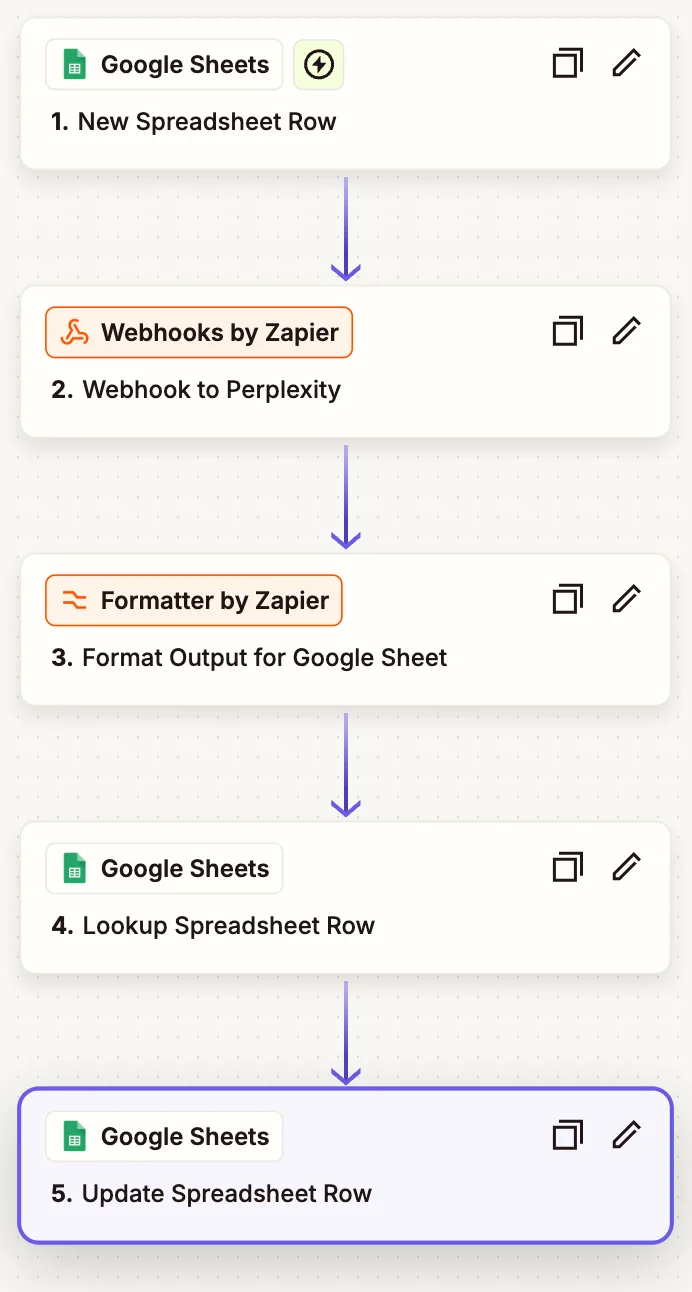
- I set up a Zapier workflow that triggered whenever a new row was added. The trigger called Perplexity’s API to retrieve and populate the missing details automatically.
-
Troubleshooting with AI
- This was the most technical step and where AI became a game-changer.
- When errors cropped up in Zapier’s API integration, I turned to ChatGPT. It helped me write and debug the webhook code needed for the process—a task I’d never tackled before.
- With ChatGPT’s guidance, I fixed the issues in minutes, transforming what felt like a daunting challenge into an empowering experience.
-
Iterating for Success
- I refined the API prompt to ensure it returned accurate, relevant data.
- Each iteration brought me closer to a seamless, automated workflow that delivered exactly what I needed.
The Outcome: Practical Results and Personal Growth
-
Efficiency: The automated workflow enriched my dataset in real time, saving hours of manual research.
-
Cost-Effectiveness: For just $10, I achieved results that would have required costly tools or significant outsourcing.
-
Confidence: Writing a webhook and troubleshooting technical issues felt like a breakthrough, showing me that AI can help anyone tackle challenges beyond their skill set.
However, it’s important to note that this solution was tailored to solve a specific, immediate problem. If you’re dealing with ongoing or large-scale data challenges, dedicated tools like LinkedIn Sales Navigator or ZoomInfo may be better suited to your needs. These platforms provide robust, repeatable data enrichment capabilities that can save you time and effort in the long term.
Reflecting on this experience, I realized something profound: AI doesn’t just solve problems—it empowers you to tackle challenges that once felt out of reach.
Expanding the Possibilities: Two Real-World Use Cases
While my use case focused on data enrichment, the potential applications for AI-powered automation are limitless. Here are two ideas to inspire your next project:
1. Automating Lead Qualification
Problem: Sales teams waste hours manually researching lead details like company size and location.
Solution:
- Use AI-powered APIs to retrieve missing lead details.
- Automate this process with a Zapier workflow that updates your CRM or Google Sheet.
Result: More targeted outreach and faster lead qualification.
2. Personalizing Customer Communications
Problem: Generic emails fail to engage customers due to incomplete data.
Solution:
- Use AI to analyze customer behavior and enrich profiles with preferences or purchase history.
- Automate personalized campaigns with tools like Make or Zapier.
Result: Higher engagement and stronger relationships.
These examples highlight the versatility of AI-powered solutions, empowering professionals to save time, enhance personalization, and drive better results.
Framework for Getting Started
If you’re inspired to try AI-powered problem-solving, here’s a simple framework to guide you:
- Identify the Problem: Look for repetitive or time-consuming tasks in your workflow.
- Collaborate with AI: Use tools like ChatGPT to brainstorm solutions, refine prompts, or troubleshoot errors.
- Automate with Tools: Implement your solution with accessible platforms like Zapier or Make.
- Iterate and Learn: Start small, refine your approach, and build confidence as you go.
The key is to start experimenting. Each step forward brings you closer to unlocking AI’s potential.
Overcoming the Fear of Experimentation
One of the biggest barriers to adopting AI is the fear of failure. But here’s the truth: small wins build big confidence.
- Embrace Imperfection: My first webhook wasn’t perfect—but with AI, I fixed it.
- Think Progress, Not Perfection: Each experiment moves you closer to mastery.
- Start Small: Focus on one problem to solve, then expand your horizons.
Experimentation isn’t just a learning process—it’s an empowering one.
Upskilling for the Future
The future belongs to those who embrace AI.
- Learning to use AI tools like ChatGPT and Zapier isn’t just a skill—it’s a superpower.
- By automating routine tasks, you’ll free up time for the work that matters most.
- And the best part? You don’t need to be a developer to start.
Your Turn to Experiment
What’s one problem you’re facing this week? Could AI help you solve it faster, smarter, or better?
Take the first step: identify a task, collaborate with AI, and see what’s possible.
At Pallas Advisory, we help professionals and SMBs unlock the potential of AI and automation. Whether you’re optimizing workflows or tackling unique challenges, we’ll guide you every step of the way. Let’s create something amazing together.