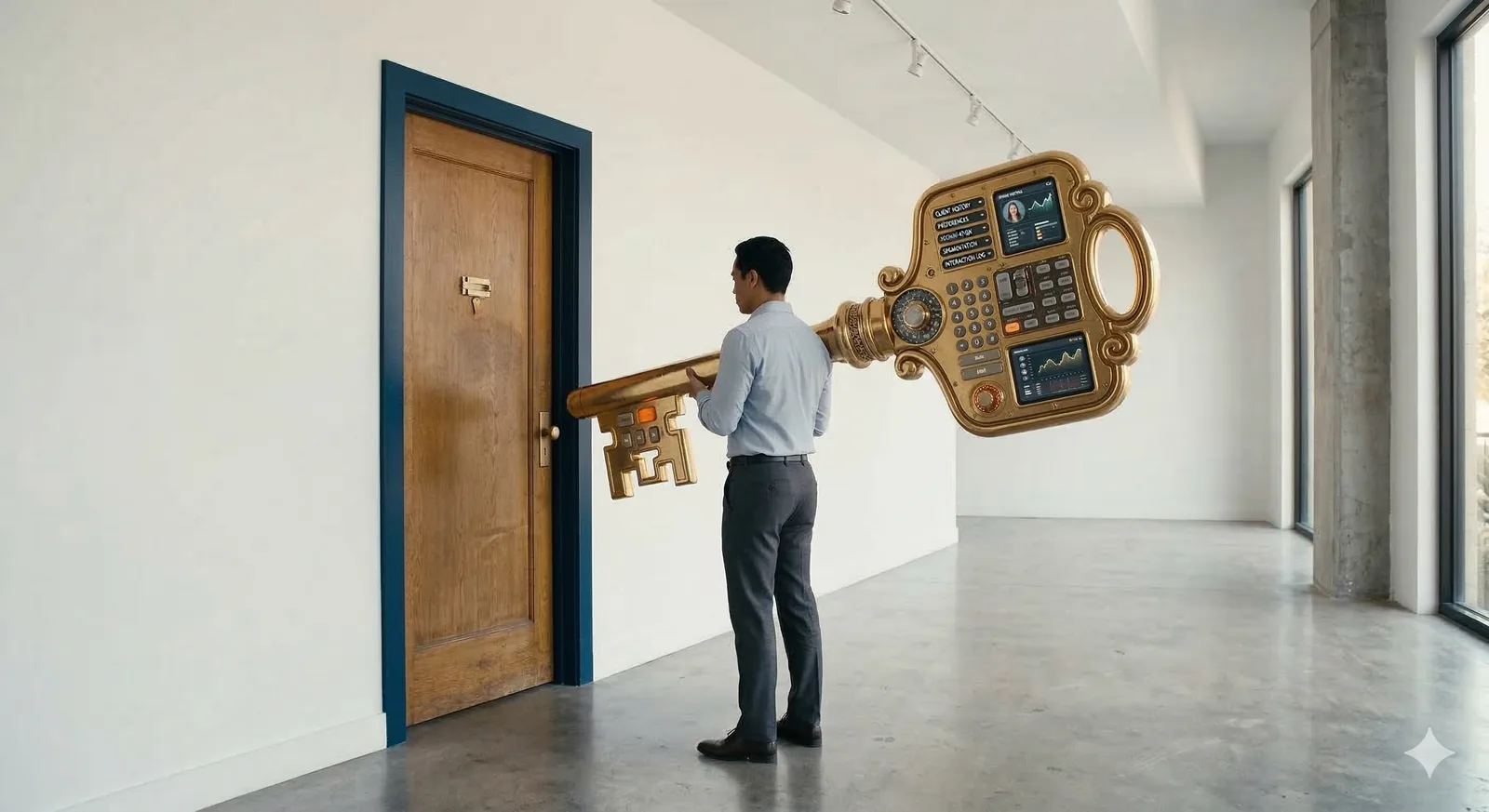

The marketer who uses AI to draft ten subject line variations, but still decides which one says something true about what changed for the reader, is getting more valuable. Whoever’s manually pulling last week’s open-rate numbers into a spreadsheet every Monday is not. It’s the same technology doing both to them.
PwC’s 2026 AI Jobs Barometer calls this a two-track labor market. Their own examples sit further from a marketing team’s world: radiologists and recruiters on one track, IT service managers and medical secretaries on the other. On the first track, AI reads the scan or screens the resume, and a human still decides what it means. On the second, AI absorbs the complex part too, and the human role shrinks around whatever’s left. Swap in your own job titles and the mechanism doesn’t change. Those first-track jobs are growing twice as fast as the second, with 42% faster wage growth since 2021.
Same technology. Opposite outcome. The difference isn’t the job title. It’s which half of the job AI ends up doing.
The Sorting Decision Nobody’s Making on Purpose
Big companies make this split at the department level. An entire function gets reorganized around AI amplifying the specialists, or an entire function gets reorganized around AI absorbing the work and needing fewer people to run it. Either way, someone decided, on purpose, which track that department was on.
A five-person business doesn’t have departments to sort into. You have one person doing both kinds of work in the same afternoon: a judgment call with a client at 10am, then an hour of repetitive admin at 11 that could run itself. Nobody draws an org chart around that. Which means nobody’s making the sorting decision either. It just happens by accident, task by task, usually toward whichever default is easiest that day.
I make a version of this call constantly, just small enough to see clearly. Reading a new client’s operation for the first time and figuring out what’s actually broken stays entirely with me. That’s judgment nothing else in my business can do yet, mine or an AI’s. Combing through call transcripts for a pattern I might have missed, or drafting the first pass of a document I’ll heavily edit? That goes straight to Metis, the AI agent I built for research, and I check the output before it’s useful, not before it exists. I didn’t design that split on a whiteboard. I backed into it, one task at a time, by noticing which ones got worse when I handed them off and which ones didn’t.
That noticing is the whole exercise. Most small business owners never run it deliberately, and it shows up as two different failure modes depending on which way they lean. Automate the judgment call, and the work gets worse in ways that are hard to point to until a client notices first. Keep doing the repetitive task by hand out of habit or caution, and that’s the actual source of the time poverty every growth-stage owner complains about, not a lack of AI tools, a lack of sorting.
The Audit
Pick five or six tasks you or someone on your team does every week. For each one, ask a single question: if someone or something else did this task tomorrow instead of you, would the result get noticeably worse, or would nobody be able to tell?
Gets worse: that’s a professionalize-track task. Keep yourself in the middle of it. The right move is AI that makes you faster or sharper at it, not AI that replaces you in it.
Nobody can tell: that’s a democratize-track task. Get yourself out of it entirely. The right move is full automation, and every week you stay manually involved is a week you’re paying yourself a premium wage to do work that already runs at commodity price.
Sorting five tasks like this doesn’t take long. The hard part isn’t the sorting. It’s admitting that a task you’ve always done yourself belongs in the second bucket, or that a task you’ve been happy to hand off actually needed you the whole time.
A Year Ago, I Had the Instinct Without the Data
I wrote a version of this argument in July 2025, a five-point checklist for deciding whether a given task belonged to a human or an AI. It was a reasonable framework. It didn’t have real evidence behind it yet that the sorting itself was worth anything.
It is. PwC’s data says the businesses pulling ahead on productivity and wages aren’t the ones using AI the most. They’re the ones that sorted correctly, keeping people in the professionalized work and getting out of the way of the democratized work, and doing it deliberately instead of by accident. That’s not an enterprise-only finding. It’s just easier to see at enterprise size, where the sorting happens at the department level instead of getting buried in one person’s task list.
Small businesses don’t need an AI Jobs Barometer to know this dynamic exists. What this report actually offers is proof of the size of the gap between doing the sorting on purpose and doing it by accident. That gap is worth taking seriously at any size of business, not just the ones large enough to show up in PwC’s dataset.
If you want a second pair of eyes on where your own task list splits, that’s a short conversation, not a sales pitch. Happy to look at it with you.
Sources:
- PwC, “AI reshapes global labour market into two distinct paths, rewarding human skills” (press release, June 15, 2026)
- PwC, “2026 AI Jobs Barometer: Two futures for jobs in an AI era” (June 2026)
Related Reading: