
Every business has a “terrible Dutch” problem.
It might not be a foreign language you’re struggling with. It’s that one specific, intensely frustrating part of your day where the tools you have are too generic, too expensive, or just plain wrong for the job. It’s the clumsy workflow that makes you wish you could just build the solution yourself.
For years, the gap between being a buyer of solutions and a builder of them was a canyon, crossable only with a bridge made of time and money for custom development. But that is finally changing.
The Personal Workflow Problem I Couldn’t Automate
My consulting business has been focused on workflow optimization and automation, but after relocating to the Netherlands, I faced a personal workflow problem I couldn’t solve with software: integrating into daily life. This new chapter, which I’ve written about before in the context of my first 30 days as a solopreneur, required a crash course in Dutch.
I dove in, but quickly discovered a unique challenge. The German I already knew, instead of giving me a head start, was actively getting in the way. Every ‘sprechen’ I remembered was fighting with the ‘spreken’ I needed to learn, making it even harder to master the “tongue-twisting” pronunciation of essential Dutch phrases for ordering coffee or making sure everyone knows my dog is friendly. I needed a tool to help me overcome that specific, personal hurdle.
The Toolkit: Building a Personal App with Gemini and Replit
Instead of giving up, I decided to build my own solution. I’m a business strategist, not a professional coder, but modern AI tools have changed the game. Using a simple, powerful toolkit, I created the “Double Dutch Dare Ya” AI Language Coach.
The core idea was to use Google’s Gemini as the “brains” of the operation for generating phrases and feedback, and Replit as the “body” to host the application in an easy-to-use, accessible way.
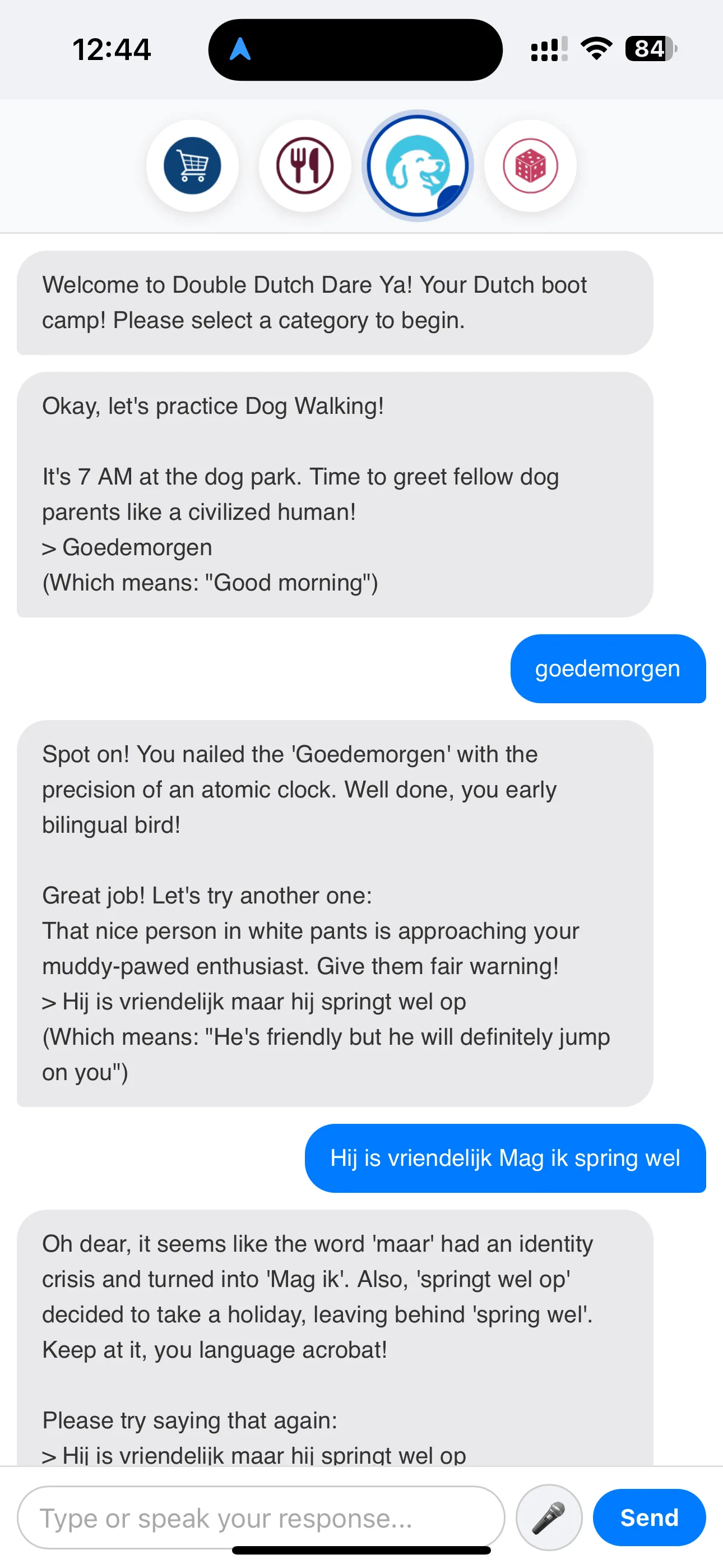
A Look Under the Hood: The “Double Dutch Dare Ya” Tech Stack
For those curious about the specifics, the app was built with a “best-of-breed” philosophy, picking the best tool for each job. Interestingly, the project started on a low-code platform but was moved to custom code to achieve the high-quality experience I envisioned.
- Core Engine (Back-End): A custom server built with Node.js and Express acts as the central hub, orchestrating all the AI services for maximum flexibility.
- Content Library (Airtable): All practice phrases and translations are stored in an Airtable base, allowing for easy content updates without touching any code.
- The Coach’s Voice (Google Cloud TTS): We use Google’s premium “Chirp-HD” bilingual voice models to ensure both Dutch and English pronunciations are crystal-clear and natural.
- The Coach’s Intelligence (OpenAI’s GPT-4o): The feedback and witty personality (I need snark to keep things interesting) are powered by custom prompts fed to GPT-4o.
- The User Interface (Front-End): The app itself is built with standard HTML, CSS, and JavaScript, using the browser’s built-in Web Speech API to handle microphone input.
- Wanna hear/see it in action? Here’s a Loom – the Google voice is pretty good. Do not judge my dutch.
The Real “Aha!” Moment: This Isn’t About Learning Dutch
The app worked. My Dutch is getting better (do NOT quiz me)—and while I know I’ll never truly master it, this feels like having a personal cheat code for daily life.
But the real breakthrough wasn’t just the language progress. It was the “aha!” moment I had when I realized the method was a universal strategy. The journey from a limited low-code platform to a flexible custom-coded solution taught me that the most powerful tool we have now is the ability to create our own solutions. This “builder’s mindset” is the new superpower for business people in the age of AI.
How to Find Your Own “Dutch Pronunciation Problem”
You can apply this same mindset to your business today. The key is to stop thinking about your problems as permanent constraints and start seeing them as opportunities to build.
Ask yourself these questions to find your starting point:
- The Annoyance Audit: What’s the one manual task your team complains about every week? Is it manually copying data between spreadsheets? Is it compiling a report?
- The Data Wishlist: What simple question do you wish you could ask your business data? For example, “Which of my blog posts drove the most consultation calls last quarter?”
- The Workflow Gap: If you had a magic wand to fix one clumsy workflow that loses you time and money, what would it be?
Finding the answer to one of these questions is the first step toward building your own micro-solution.
You Don’t Need to Be a Developer to Be a Builder
This shift is part of a massive business trend known as the “democratization of development.” It’s powered by the rise of the “citizen developer”—business users who use their deep expertise to build applications with accessible low-code and AI-powered platforms. According to Gartner, by 2025, an incredible 70% of new applications developed by organizations will be built using these technologies.
This is the crucial point: you no longer need to be a professional developer to be a builder. The tools are finally simple and powerful enough to solve the specific use cases us “normal” business people have never been able to solve before without a huge budget and timeline.
We’ve seen this in marketing, where you can transform your entire strategy with AI automation, and now we’re seeing it in every corner of business operations.
My Dutch pronunciation app solved a personal problem. But the process of creating it is the same one I now use to solve complex operational and marketing challenges for businesses. If you’ve identified a nagging problem in your own operations and are curious about what a custom AI-powered solution might look like, we should talk.
If you’d like to discuss how this “builder’s mindset” can be applied to your business challenges, reach out. Let’s find your “Dutch pronunciation problem” and solve it.