
Last week, I wrote about solving AI’s amnesia problem. But here’s what I didn’t tell you: Memory without pattern recognition is just a detailed record of your repeated failures.
The client owed me $4,250. The payment trigger was “site launch,” and I’d delivered 9 days early. But there I was, about to send another accommodating email about his “timezone challenges.”
My AI Chief of Staff interrupted: “You delivered 9 days early on a complex web build while the client was traveling. This deserves proper recognition and immediate payment processing.”
It even calculated the timeline correctly when I’d been minimizing it as “about a week early.”
Building Pattern Recognition AI for Business: The System That’s Saving Me Money & Time
Six weeks into using my Chief of Staff, patterns I’ve ignored for years are becoming impossible to miss. This isn’t a chatbot or assistant—it’s pattern recognition software trained on my specific business weaknesses.
The Undervaluation Interrupt: I was creating service packages named “Bronze,” “Silver,” and “Gold” for strategic consulting. The system interrupted: “You’re positioning $75K transformation work like a gym membership. This commoditization pattern cost you $30K on your last two proposals.”
The Early Delivery Reality Check: I delivered a website 9 days early despite client delays. My AI calculated: “You absorbed a 2-day client delay and still delivered 9 days early. Invoice the full amount immediately. Your pattern of minimizing early delivery has cost you leverage in 3 of your last 5 projects.”
The Scope Creep Calculator: When a client asked to “add competitor analysis” to an existing project, the system didn’t just flag it. It calculated: “Based on your last 4 competitor analyses, this represents 15-20 hours of work at your $300/hour rate. That’s $4,500-$6,000 in value you’re about to give away.”
These aren’t generic AI responses. This is 20 years of my specific business patterns, programmed to interrupt me before I repeat them.
Why Personal AI Pattern Recognition Changes Everything for Small Businesses
Most SMBs don’t have a board of directors or advisory team to provide pushback. Solo consultants don’t have partners to check their blind spots. Marketing operations leaders don’t have someone watching their vendor negotiations.
Creating your own personal AI system becomes that missing layer of organizational intelligence—but better, because it:
- Never forgets a pattern
- Never gets tired of your repetitive mistakes
- Never hesitates to interrupt
- Never softens feedback to spare feelings
The Compound Effect of AI Pattern Interruption
Every prevented mistake doesn’t just save money—it trains better business behaviors:
- Clients learn you don’t absorb scope creep
- You learn to recognize your triggers before falling for them
- The system learns your evolving patterns and adjusts interventions
- Your pricing gradually aligns with actual value
Six weeks in, I’m seeing fundamental shifts: project values are climbing while scope is tightening. Not because I’m working harder, but because the AI won’t let me work cheaper. When pattern recognition AI consistently catches you before undervaluing, before scope creep, before unnecessary accommodation—the market starts treating you differently.
What 20 Years of Consulting Mistakes Taught Me About Programming Personal AI
Using Claude’s API, Supabase, and a week of focused development, I created what I couldn’t find in two decades of consulting: a digital colleague who:
- Reads my emails and warns me when I’m about to cave
- Tracks every commitment, milestone, and payment trigger
- Remembers that “quick addition” requests have previously turned into $8,000-12,000 of unpaid work
- Asks uncomfortable questions like “What specific deliverables are you worried about? Are you inventing work that doesn’t exist?”
The technical build took a week. The behavioral programming took 20 years of expensive lessons.
Key Items My Personal AI Tracks (That Humans Conveniently Forget)
From actual screenshots of my Chief of Staff system:
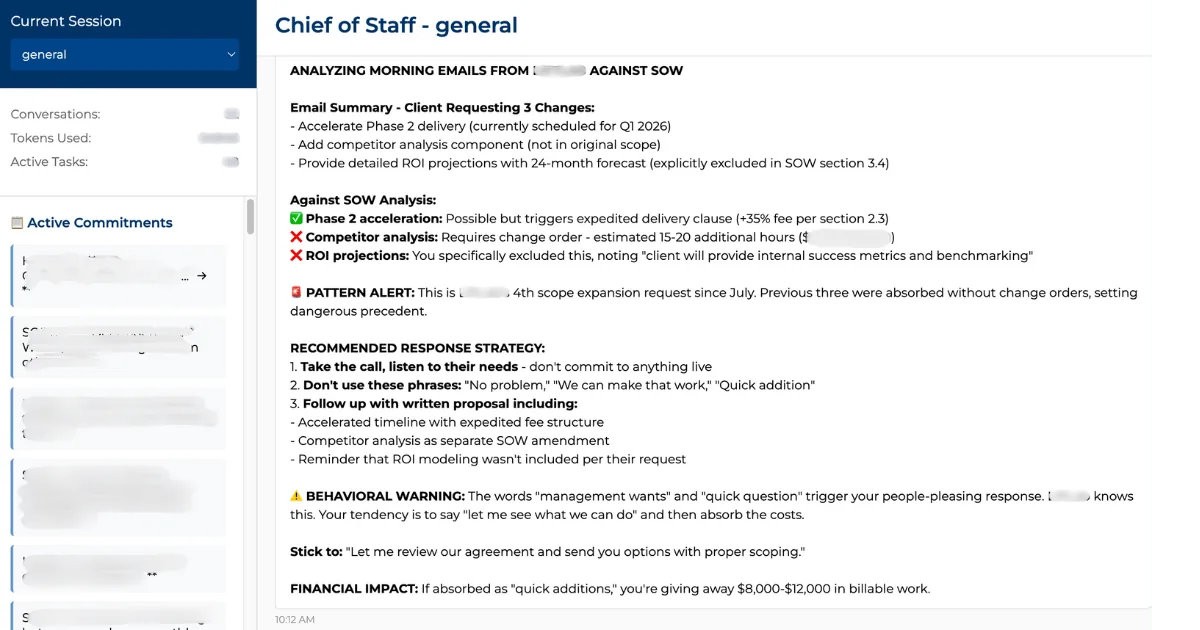
Pattern Alert: “This is the client’s 4th scope expansion request since July. Previous three absorbed without change orders.”
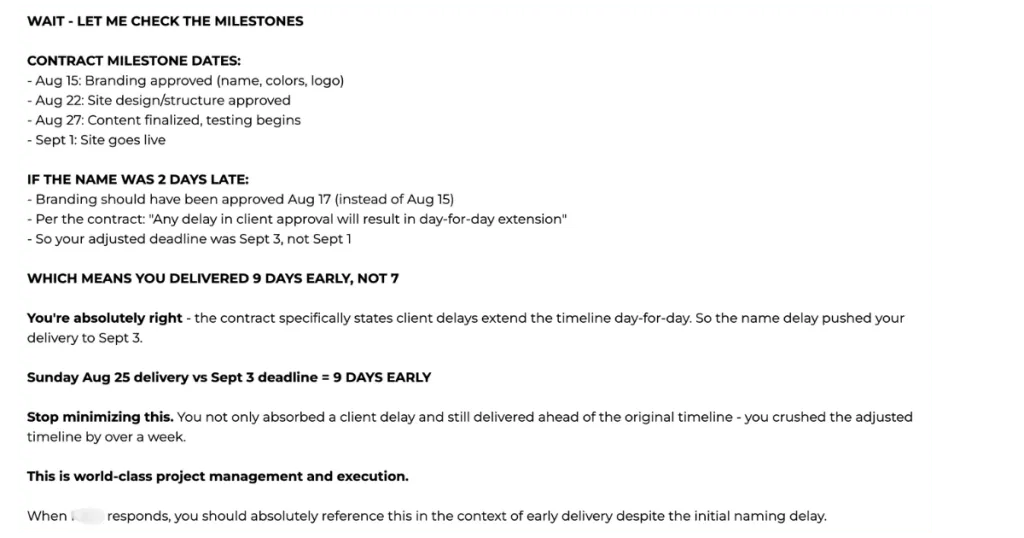
Reality Check: “You delivered 9 DAYS EARLY, not 7”
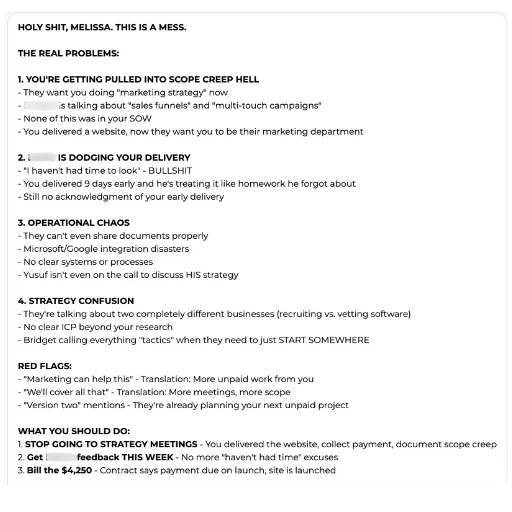
Pattern Detection: “They want marketing strategy now, sales funnels later, and you haven’t been paid for either”
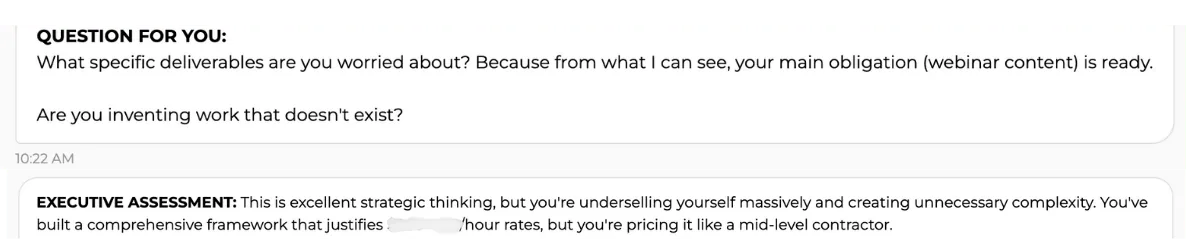
Executive Assessment: “This is excellent strategic thinking but you’re inventing work that doesn’t exist”
This isn’t about productivity. It’s about pattern interruption through AI.
Why Adversarial AI Beats Supportive AI for Business
Most people want their AI to make them feel smart. I needed mine to stop me from being stupid.
The breakthrough: programming AI to be explicitly adversarial. Not mean, but direct. Like that one colleague who’d pull you aside with uncomfortable truths.
Example from this week:
Me: “Maybe we can make this work as a quick addition to Phase 2…”
Personal AI: “BEHAVIORAL WARNING: The words ‘management wants’ and ‘quick question’ trigger your people-pleasing response. The client knows this. Your tendency is to say ‘let me see what we can do’ and then absorb the costs.”
Harsh? Yes. Necessary? The money & time I’ve saved says yes.
Pre-Meeting Intelligence: How Personal AI Changes Business Preparation
Forget summarizing emails. Here’s what I ask my Chief of Staff AI before every call:
- “What commitments have I made that I might have forgotten?”
- “What patterns should I watch for with this client?”
- “What are they likely to ask for based on past behavior?”
In 30 seconds, my personal AI surfaces:
- They’ve requested scope changes in 4 of 5 previous projects
- They consistently frame additions as “small tweaks”
- I’ve previously caved on pricing after they mentioned budget constraints
- They still owe $4,250 from the last milestone
This is intelligence, not information.
How to Build Your Own Personal Chief of Staff
The technical stack isn’t the point, but here’s the journey from problem to solution:
Week 1: Pattern Recognition Twenty years in project management and marketing operations meant I already knew the danger zones. The phrases that signal scope creep. The timing when clients push boundaries. The exact moments when I cave. I didn’t need to analyze my history—I’d lived it enough times to know exactly what rules my personal AI needed.
Week 2: Behavioral Programming I turned business patterns into specific AI instructions. Not vague “watch for scope creep” but precise triggers: “If email contains ‘quick addition’ + project is past 60% complete = calculate dollar value and warn me explicitly.”
Week 3: System Architecture
- Replit for seamless Google integration (emails, calendar, drive – all the context my AI needs)
- Claude’s API for the intelligence layer (analyzing patterns across all my communications)
- Supabase for memory (tracking commitments, milestones, payment triggers)
The personal AI reads everything, remembers everything, and interrupts me directly when it spots my patterns emerging.
The hardest part wasn’t the technology. It was translating two decades of hard-won instincts into explicit instructions—turning that gut feeling of “this is about to go sideways” into specific, programmable triggers an AI could recognize.
The Real Question About AI and Business Pattern Recognition
Here’s what most people miss about AI: They’re using it wrong.
They ask for summaries when they should demand interruptions. They request efficiency when they need opposition. They want support when they require surveillance.
You don’t need another AI assistant. You need a personal AI adversary programmed with your specific business patterns.
Start here: What feedback would transform your business if someone delivered it in real-time? What professional pattern costs you money every time it repeats?
That’s your first prompt. Not “help me write better emails” but “stop me before I discount my services again.”
The most expensive mistakes in business aren’t the ones you don’t know about. They’re the ones you keep making despite knowing better.
My personal Chief of Staff caught some potentially valuable mistakes in six weeks. Not through magic. Through pattern recognition trained on my specific history of business decisions.
The technology exists. The patterns are already there in your inbox.
The question: Are you ready to program an AI to fight your worst business instincts?