
How AI Tools Are Accidentally Creating More Work (And the 3-Step Fix)
TL;DR
- The Hidden Crisis: Companies spending 300% more on AI tools while teams work longer hours—because they’re adding AI to broken processes instead of fixing them
- The Shadow Reality: 38% of your team is already using unauthorized AI tools with company data, creating invisible compliance and security risks you don’t know about
- The Strategic Miss: Most businesses are optimizing for tool adoption instead of workflow efficiency, turning AI from a competitive advantage into an operational nightmare
- The Framework: A proven 3-step audit system that prevents expensive AI failures before they happen
“We’re More Productive Than Ever… So Why Does Everything Feel Harder?”
The data is shocking, but also hilariously predictable.
A major 2024 study by the Upwork Research Institute revealed a stunning disconnect: 96% of C-suite leaders expect AI to boost productivity, but 77% of employees using AI report these tools have actually increased their workload.
The numbers get worse:
- 47% of employees don’t know how to achieve the productivity gains their employers expect
- 39% spend more time reviewing and moderating AI-generated content
- 23% invest more time learning how to use multiple AI tools
- 21% are asked to do more work as a direct result of AI implementation
Three months ago, a manufacturing SMB owner called me, living this exact reality. His team had adopted ChatGPT, Jasper, Copy.ai, and Canva’s AI features. Software costs jumped from $800 to $2,400 monthly. The team was creating 4x more social media content.
“But here’s what’s driving me crazy,” he said. “My marketing manager is working until 8 PM every night now. She used to leave at 5:30. We have more content than ever, but I can’t tell you if any of it’s actually working because she spends all her time just… managing the tools.”
Here’s the uncomfortable truth: Most companies implementing AI aren’t getting more efficient. They’re getting busier—and paying handsomely for the privilege.
The Psychology Behind the AI Addition Trap
After implementing enterprise tech stacks like Salesforce, Invoca, Eloqua, and Wrike for over a decade, I’ve seen this pattern before. But AI has accelerated it dramatically.
The root cause isn’t technical—it’s psychological. When teams feel behind on AI adoption, they default to addition thinking instead of optimization thinking.
Why Smart People Make This Mistake
The Urgency Bias: “Our competitors are using AI, so we need to use AI.” This pressure leads to tool accumulation rather than strategic implementation.
The Shiny Object Syndrome: Each new AI tool promises to solve a different problem. ChatGPT for writing, Jasper for marketing copy, Copy.ai for emails. What looks like comprehensive coverage is actually tool sprawl.
The Sunk Cost Trap: Once you’re paying for multiple tools, canceling any of them feels like admitting failure, even when they overlap significantly.
The Documentation Gap: Nobody maps their actual workflows before adding AI. Teams assume they know where the bottlenecks are—and they’re usually wrong.
I learned this lesson working with a client who was convinced they needed AI for social media content creation. When we actually audited their process, content creation took 2 hours weekly. Content approval and posting took 8 hours. The bottleneck wasn’t creation—it was workflow management. But they’d spent six months optimizing the wrong problem.
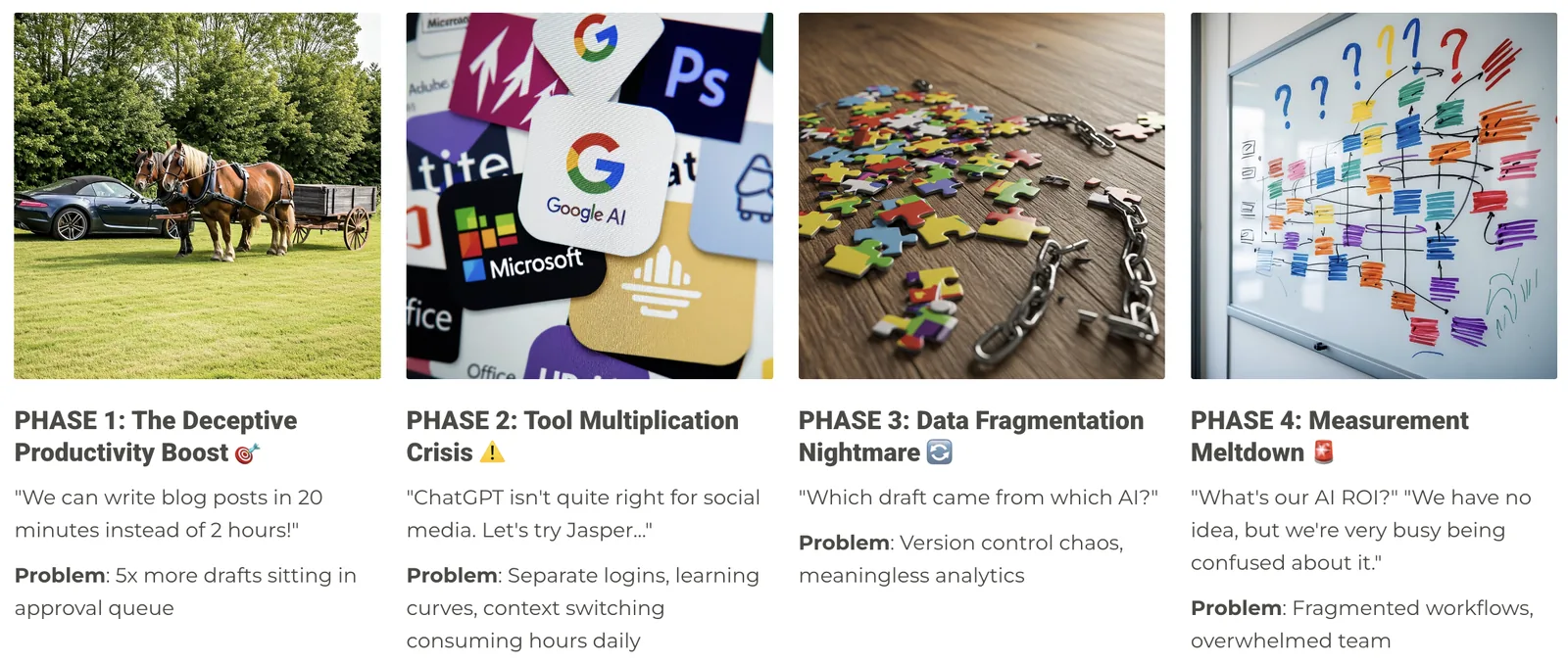
The Four Phases of the Death Spiral
The Shadow AI Crisis Nobody Talks About
While companies debate official AI policies, 38% of employees are already sharing sensitive data with unauthorized AI tools, according to Cyberhaven research. It’s like having a front door security system while leaving all the windows wide open.
The scope is staggering:
- 485% increase in corporate data fed into AI tools between March 2023-2024
- Over 50% of AI users rely on personal accounts vs. company-approved tools
- 73% more data flows out of professional services firms via AI than flows in
Here’s what’s actually happening in your company right now:
Your marketing coordinator screenshots internal performance dashboards and uploads them to Claude on her personal phone to generate reports—because apparently, data security is just a friendly suggestion now. Your sales manager feeds prospect lists into ChatGPT to write follow-up emails. Your content writer uses Perplexity to research competitors, inadvertently sharing your positioning strategy with an AI that has the memory retention of a particularly chatty parrot.
They’re not being malicious. They’re being resourceful. But this creates a parallel “shadow tech stack” operating outside your governance, invisible to IT, unmeasured by leadership—and about as secure as leaving your laptop in a coffee shop with a sticky note saying “please don’t hack this.”
Samsung discovered this when employees uploaded proprietary code to ChatGPT for debugging. The breach forced them to ban ChatGPT entirely—after the damage was done.
The real danger: You’re probably making strategic decisions based on incomplete data while your actual AI usage patterns remain invisible.
The True Cost of AI Chaos
The Productivity Paradox
Research shows it takes 23 minutes to refocus after context switching. A team managing 5 AI tools loses 2+ hours daily just to switching overhead. Add data re-entry between non-integrated systems, version control management, and training on multiple platforms—teams spend more time managing AI than benefiting from it.
The Financial Death by a Thousand Subscriptions
Instead of strategic tool selection, companies accumulate:
- ChatGPT Plus: $20/user/month
- Jasper: $49/user/month
- Copy.ai: $36/user/month
- Canva Pro: $15/user/month
- Perplexity Pro: $20/user/month
For a 5-person team: $8,400 annually in AI subscriptions alone—enough to hire a part-time person to manage all the tools you bought to save time. The irony is so thick you could cut it with a poorly-prompted AI-generated knife.
The Strategic Blindness
When workflows become Frankenstein monsters of connected tools, you lose:
- ROI visibility: Which tools actually drive results?
- Process scalability: Systems held together with digital duct tape can’t grow
- Quality control: Output quality varies wildly across platforms
- Strategic agility: Can’t pivot quickly when processes are overly complex
The 3-Step Strategic Implementation Framework
After a decade implementing enterprise marketing technology and watching companies make the same mistakes repeatedly, here’s the framework that actually works:
Step 1: The Brutal Workflow Audit (Process Before Tools)
Before you can fix anything, you need to know exactly where you stand. Most companies skip this step and wonder why their AI implementation feels like organized chaos.
Start with our diagnostic: Take the “Are You Stuck in the AI Death Spiral?” assessment to get an immediate read on your current situation. It takes 2 minutes and will tell you whether you’re heading for strategic success or expensive disaster.
Then dive deeper with the 5 Critical Questions:
- Where do tasks actually take longer than they should?
- Where does work sit waiting for someone else?
- Where do you recreate the same information multiple times?
- Where do quality issues most commonly occur?
- Where does your team feel most frustrated with current processes?
Calculate True Baseline Costs: Not just “how long does content creation take” but “how long does content creation, review, revision, approval, scheduling, and performance tracking take?”
Define Measurable Success: “Faster content creation” isn’t success. “Same quality content with 40% less total time from concept to publication” is success.
When I audit workflows with clients, 80% discover their assumed bottleneck isn’t their actual bottleneck. It’s like going to the doctor complaining about a headache when you actually have a broken leg—you’re treating the wrong problem with expensive solutions that don’t help.
Step 2: Strategic Replacement, Not Addition
The Integration-First Principle: Choose tools that eliminate existing steps rather than add new ones. If AI can draft social posts, eliminate separate brainstorming sessions. If AI handles first drafts, reduce review cycles from 3 rounds to 1.
The Consolidation Test: Before adding any tool, ask: “What existing tool or process will this replace?” If the answer is “nothing,” you’re about to create tool sprawl.
Change Management Is 80% of Success: The technical setup is easy. Getting organizational buy-in, retraining workflows, and establishing new quality standards is the real work.
This is exactly where that social media project I mentioned earlier failed. Great tool integration, zero change management. The AI sat unused because the human systems weren’t ready—like buying a smart home system but never telling anyone in your family how to turn on the lights.
Step 3: Measure Efficiency Gains, Not Output Volume
Track Time Saved, Not Content Created: If you used to spend 6 hours on social media weekly and now spend 3 hours (including AI generation and editing), that’s success—regardless of whether you create more posts.
Establish Shadow AI Governance: Create clear policies about approved tools, data sharing guidelines, and regular audits of actual tool usage vs. approved tool usage.
Monthly Optimization Reviews: Which tools are actually being used? Which processes are working? Where can you consolidate further?
ROI Measurement Framework: Each tool should have a clear business case with measurable outcomes. If you can’t explain why you need both Jasper AND Copy.ai, you probably don’t.
The Strategic Advantage Window Is Closing
Your competitors are making these same mistakes right now. But this window of opportunity won’t last. Companies that implement AI strategically—focusing on workflow optimization rather than tool accumulation—will establish sustainable competitive advantages while others burn resources on digital busy work.
The companies that will win are those that:
- Solve real bottlenecks instead of perceived ones
- Optimize workflows instead of just adding tools
- Measure efficiency instead of output
- Govern their entire AI ecosystem instead of just their “official” tools
Your 48-Hour Action Plan
Hour 1: Take the AI Death Spiral Diagnostic to get your baseline assessment
Hours 2-4: Survey your team anonymously about which AI tools they’re actually using (including personal accounts)
Hours 5-10: Map one critical workflow completely, documenting every step, handoff, and delay
Hours 11-12: Calculate the true cost of your current AI tool stack, including staff time for management
Hours 13-14: Identify which tools overlap and which processes could be consolidated
Next 34 Hours: Schedule strategic review sessions to determine which tools add value vs. create busywork
The Choice That Defines Your Next Two Years
Every day you delay strategic AI implementation, your workflows become more fragmented, your costs multiply, and your competitive position weakens.
The businesses thriving with AI aren’t the ones with the most tools—they’re the ones with the most optimized processes.
While your competitors fall into the death spiral, you have a brief window to implement AI strategically and establish a lasting advantage.
The question isn’t whether you’ll use AI. It’s whether you’ll use it strategically or let it use you.
Want to talk through your version of this? Email me.
Stay ahead of the AI curve by subscribing to the weekly “AI Strategist” newsletter for practical insights on leveraging AI in your marketing operations.
Further Reading & Sources
- Upwork Inc. (2024). “Upwork Study Finds Employee Workloads Rising Despite Increased C-Suite Investment in Artificial Intelligence“
- IBM (2025). “What Is Shadow AI?“
- Cyberhaven (2024). “Shadow AI: how employees are leading the charge in AI adoption and putting company data at risk“
- Zendesk (2024). “What is shadow AI? Risks and solutions for businesses“